Showing posts with label train. Show all posts

Friday, June 18, 2010

11/11 - Modern Transportation Museum

H being the transit geek that he is, the Modern Transportation Museum was high on his list of places to visit.  Fortunately for us, we still had another day on our Osaka Unlimited Pass and it included 20% off of admission to the Transport Museum.

From the guesthouse of the Taiwanese lady, we hopped onto the Chuo Line [中央] at Hommachi [本町]Station and rode the subway to Bentencho [弁天町]Station.  A very quick ride at ¥230.

Originally, we thought that breakfast was included in our accommodation at the guesthouse, but we found out that it wasn't the lady at the guesthouse explained that it cost extra to have food included.  This differed from what N's travel book and the website had suggested.  N said that it was probably because she hadn't looked at the website for a few months.  We weren't originally expecting to stay at the guesthouse; it was a last-minute addition to our itinerary.

So without breakfast in our tummies, we promptly stepped into a McDonald's right by Bentencho [弁天町] Station.  It was still fairly early in the morning and there were a lot of teens in their school unis taking in breakfast before heading to class.  McDonald's in Japan has such a dizzying array of choices for their meals.  H had a Salad Marinade McMuffin with Cafe au Lait (H loves Japanese McD's cafe au lait).  N had a regular Sausage McMuffin with juice in a Tamagotchi cup.

After a quick bite, we were first in line for the museum this rainy rainy day.  There was a lot on display at the Modern Transportation Museum. The museum is divided into many rooms that are all to the left of the main hallway.  The rooms are more like sections because there are no doorways to go through.
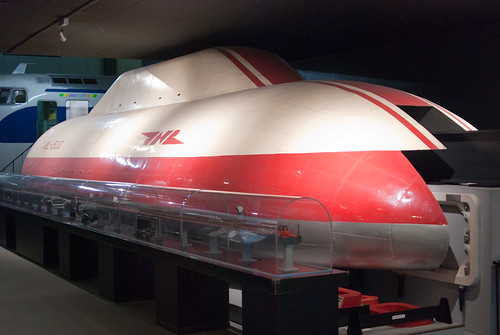


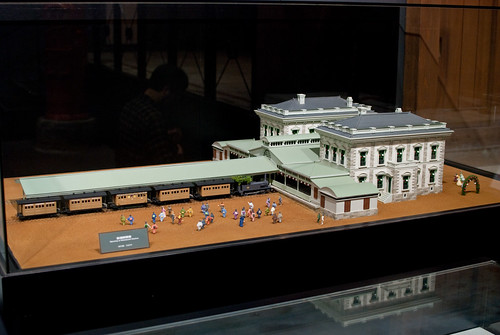
The museum starts oddly enough with a section about the technology of tomorrow.  There is a large magnetic levitation prototype on display and some smaller models of the Shinkansen [新幹線], Japan's famous bullet train.  Then after visiting the future, you step back into the past to the birth and growth of the railway in Japan. No shortage of dioramas here.
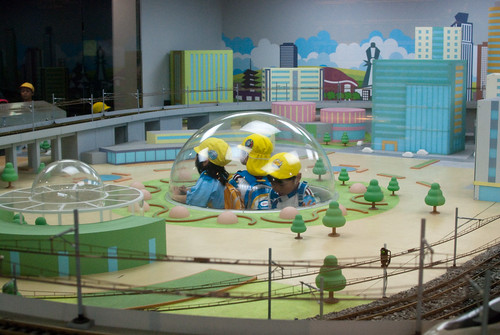
Then you come across an interactive section where you can control some of the models on display.  They obviously made the place accessible to preschoolers because there was a section in the middle of the interactive models where little kids could sneak in and pop there heads up in a bubble.  We totally lucked out because a preschool was on a field trip to the museum.  The kids made for some fun candids.


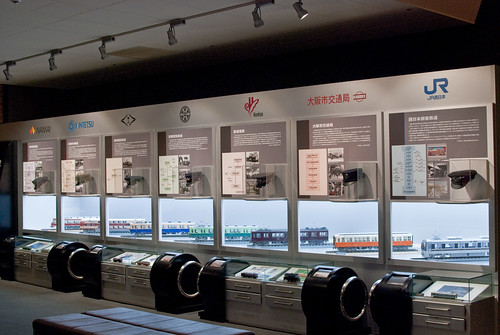
In another section, they focused on the current "rolling stock" or trains of the Kansai region.  They had displays for each major railway company operating in the area.  There was a lot to look at, but not everything was in English.  I'm sure H would have spent a whole here if he could.

Along the back of the sections, there was a life-size mock-up of a Shinkansen train complete with a drivers' cabin.  You could try your hand at operating a train or take your chances as "rail kill" in front of the bullet train.


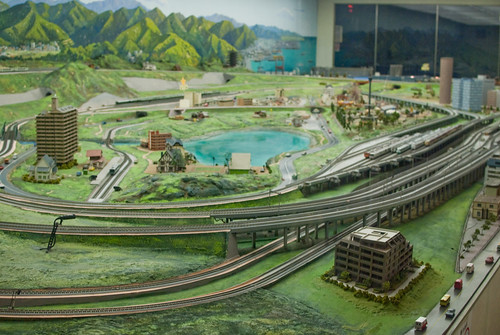
All the way at the very end of the museum, just past the one section on non-train transportation, there was the giant Model Train Panorama Room.  Did I say the Japanese love their dioramas and miniatures.  This was a large miniature world of rail just behind a large number of windows.  It was impressive.  We were lucky we beat the kids into the room; otherwise, we would have had to fight for spots along the glass and with their fingerprints all over the place.  This is one of those places that H wishes he had an ultra wide angle lens for his camera.

After wandering around some of the other exhibits and the actual trains parked outside the museum, H had to visit the gift shop.  After deliberating on what souvenir to purchase, he finally settled on two small model trains.  One was a maroon Hankyu [阪急] train like one we had ridden on our way to Arima Onsen [有馬温泉].  The other was the Narita Express, which we had ridden back in 2006 to get us from the Narita Airport to Shinjuku [新宿]in Tokyo.  Soon enough, it was time to get going again.  Next station: the Osaka Museum of Housing and Living.

Friday, November 27, 2009

Kansai - planning to get around

H continuing the blog here...

One of the hardest things about travelling in a foreign country is figuring out what the best way to get around is.  When I looked initially at the transportation maps for Osaka and the surrounding Kansai region, my eyes just boggled.  It looked like a tangle mess of coloured lines running in every direction, with a minor exception of a nice big circular loop line in Osaka.  Needless to say, we needed planning.


One of the things about most transit systems in Asia is that you pay per ride and you pay by distance.  So finding the cheapest ride is not necessarily the fastest ride.  Ideally, we needed to have as little transfers as possible, so finding direct routes is best.  The other major wrinkle is that there are at least 7 different train companies running in the region in and around Osaka.  So once you change from one company to another, you have to pay again.

N did a lot of calculations and recalculations about what combinations would give us the best bang for our buck.  She really poured over the different websites and entered different permutations in a spreadsheet.  She even had to go into the Japanese side of many websites to access trip fare calculators to see what a trip would cost.  I'm very thankful that she has more of a mind for math than I do.

One thing that a lot of people buy before heading to Japan is a JR Rail Pass.  However, we weren't planning to travel outside of the Kansai area and we weren't going to be riding the Shinkansen.  So the JR Rail Pass looked like a waste of money for us.  Especially since there are 6 other rail companies that criss-cross the region.

One thing that we decided to get is the Kansai Thru Pass (or Surutto Pass).  What is wonderful about this pass is that it gives you unlimited travel on 6 of the 7 major train companies in the Osaka area for the duration of the pass.  The pass covers almost all rail except JR Lines.  We had the option of a 2-day or 3-day pass.  The 2-day pass costs ¥3,800 and the 3-day pass costs ¥5,000.  The pass must be purchased at select locations.  If you're flying into Kansai, then it's best to buy it right at the airport.  The Kansai Thru Pass also gives you coupons to use at select locations, like a tourist attraction.  Sometimes you get a small discount or you get a small complimentary gift. These coupons are only good on the days that you are using the pass.

We were planning to be in the Kansai for well over 3 days, so we needed to figure out what else to do about transport on the other days.  We knew we would be spending a lot of time in Osaka itself.  So we looked into getting the Osaka Unlimited Pass.  The Osaka Unlimited Pass has a 1-day version (¥2,000) and a 2-day version (¥2,700). Between the 1-day and 2-day passes, there is more than just the difference in time that you must consider.  The 1-day pass gives you unlimited access to 6 of the 7 major train companies within Osaka's city limits and access to the bus.  The 2-day pass only allows you unlimited access to the Osaka Municipal Subway lines, the New Tram, and the city buses.  So you have to be careful that you know which pass you have before just trying to enter a station.  Just like the Kansai Thru Pass, you can get discounts, or even free admission, to some attractions.  Again, you can only get your discounts on the day(s) that you are using the pass.  Also, the discounts are different depending on whether you have the 1-day or 2-day pass.  The Osaka Unlimited Pass can be purchased at Kansai International Airport or at one of four Osaka Visitors Information Centers.

Confused yet?  I hope not.  The two passes were life-savers.  There was one more pass that we bought when in Kansai and that's the Kyoto City Bus Daypass.  For ¥500, you get unlimited travel on almost all Kyoto City Buses.  After 3 rides on a bus, the day pass will pay for itself.  When N looked at the attractions we wanted to see in Kyoto, she noticed that many of them were not close to the train lines.  However, the buses could bring you really close to the sites.  So for the two days we planned for in Kyoto, N decided that the Kyoto City Bus Daypass was the way to go.  We just had to buy it twice.  The easiest location to get this pass would be at Kyoto Station.  At the station, either purchase the pass at the info centre or at the bus loop's info kiosk.

All right.  With transportation all planned, we ready to head off on our little adventure in Kansai.