Showing posts with label Himeji. Show all posts

Sunday, January 31, 2010

11/6 - Himeji Castle

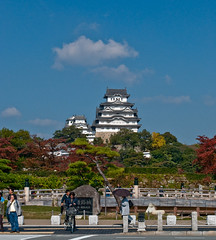
If you can only visit one castle in Japan, then it should be Himeji Castle.  It's a little out of the way, but it's well worth the trip.  This is the Japanese castle.  When I came back, my coworkers asked me if it was a real castle. Well, yes, it's a real castle.  Some of them also asked if anyone actually lived in there.  Then I realized that they were thinking of castle from a European perspective.  Castles in Europe were often where royalty and nobility lived.  I don't think a Japanese castle falls under exactly the same category.

Himeji Castle was the centre of activity and power in the area.  Japanese castles are more famous for their defensive and architectural elements.  From the many signs around the castle site, it explained how the castle would be last defense if the area were attacked.  They could huddle all the soldiers into the castle and form an impressive defense against any attackers.  The main tower itself was more of a storage and keep than a living quarter.  So in this way, it's very different from a European castle which were often residences.

We walked up the main street from the train station to Himeji Castle.  The giant white building can be easily seen from the end of the main road.  It is an impressive structure as you get closer.  There were also many other tourists in town - Japanese and non-Japanese.  It was a beautiful and sunny fall day.  We spent most of the time holding our jackets in our arms as we went around the castle grounds.

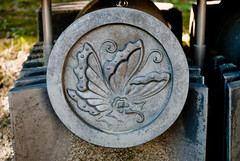
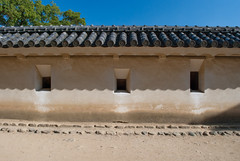
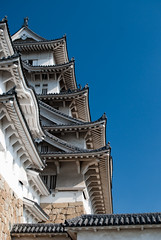
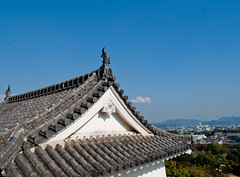
The castle grounds are made up of many buildings, but we were only really interested in the main tower.  The very front of the castle grounds are free to the public.  It's only when you approach closer to the main keep, that you must pay for admission.  Once past the admission gate, we started a series of twists and turns that took us further up towards the main tower.  It was like spiralling around the main tower to get up to the top.  There are many beautiful examples of roof tiles at Himeji Castle. In fact, there is a whole collection of different roof tiles on the buildings.


We finally reached an expansive, flat, upper area where you could look out over the town around the castle.  That's also where the main entry to the main tower was.  We went in, but there were no lights anywhere in the castle.  It looks like the Japanese were looking to preserve Himeji Castle in its original state as much as possible.  The only sign of modernity in the castle was the emergency fire equipment that was placed all around the building. 

Upon entry, we had to take our shoes off.  The ladies at the door gave us all a plastic bag so we could carry our shoes with us as we trekked upwards through the tower.  The main tower was six stories of steep stairs and large empty spaces.  The empty spaces were meant to house food and weapons in case of an attack on the castle.  Each floor was quite wide.  Again, there were no artificial lights.  So we were lucky that it was sunny outside; otherwise, we'd have a lot of trouble seeing inside the castle.  Because of the lack of lights, it was also very hard to take pictures inside the castle.  My best inside picture would be of a rack of rifles displayed on the weapons storage floor.

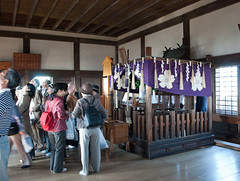
Once on the top floor, the natural light really pours in with the larger windows.  There's a little shrine built on this floor.  I'm not sure what the shrine was about because I didn't want to lose my spot in line for going back down.  However, many Japanese took the time to pay repsects at the shrine.

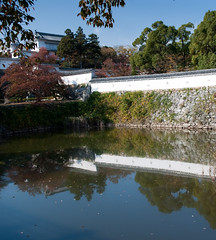
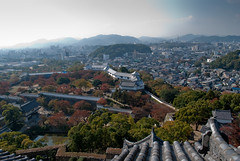
Also, there was a great view of the surrounding castle grounds.  To the west, there was another building on the castle grounds known as the West Bailey.  Then eastwards, on the way down, you could see the roofs of some of the adjacent castle buildings.
After a couple hours in the castle, we were really hungry.  It was already 2pm, so we had missed most of the lunch rush outside the castle.  There are a few restaurants directly across the road from the castle grounds.  We grabbed a quick bite and drink for lunch.  Then when we were on our way again back to Kobe.

Friday, January 29, 2010

11/6 - Arima Onsen to Kobe to Himeji

We knew today would be the day that we'd be in transit a lot.  First, we had to get from Arima Onsen to Kobe.  We were lead to believe that the bus would accept our Kansai Thru Pass.  However, after the somewhat twisty ride down the mountain and a long journey through a tunnel to the seaside metropolis, we found out from the driver that our cards wouldn't work.  We had to fork out about ¥2400 out of our own pockets.  Thank goodness Japanese buses give change!


After leaving the bus, we had to walk a while to find the correct train station. We were in the Sannomiya area of Kobe which is the central train hub for the city.  However, there are like 3 or 4 different Sannomiya stations, so we had to figure out where the Hanshin Railway station was.  When we finally found it, we unloaded our extra bags into a coin locker for the day.  That way, we didn't have to lug around too much stuff while we visited Himeji for the afternoon. 


We entered the Hanshin Sannomiya station and boarded an express train to Himeji.  Himeji is 60km west of Kobe and a one-hour journey by train. So we were very happy that we caught the express instead of the milk run that would stop at every single stop between Kobe and Himeji.  The Seaside Express was a wonderful ride.  It didn't really start that way because we were underground at first, then the train passes through the outer suburbs of Kobe.  However, once you get out of the burbs, the sky opens up and the sea is in full view to the left of the train.  It was a beautiful and clear day.  The rays of sunshine glistened off the waves and whitecaps of the ocean.  I think N may have missed most of it as she nodded off beside me.  Even the couple across from us were pretty sleepy.  For whatever reason, I didn't take my camera out at that moment, but just took in the whole view.

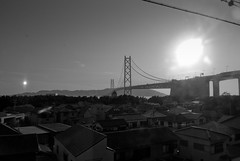
We passed the very imposing Akashi-Kaikyo Bridge that connects the main Honshu island to the much smaller Awaji Island.  For those who are into bridges, I'm sure that they would want to make a pilgrimage to this bridge that spans a pretty wide strait.  I didn't get a picture of the bridge on the way to Himeji, but I did get this shot on the way back.


After an hour, we arrived in Himeji.  I also eventually caught a little bit of shut eye along with N.  We exited the Sanyo Himeji Station and walked up the main road to Himeji to our destination - Himeji Castle.

Friday, November 20, 2009

Kansai - Preparing to go

Hi, H writing here.

Welcome to N and H's travel blog of our recent 12-day trip to the Kansai region of Japan.  If you have not heard about the Kansai region of Japan, then you're missing out. Kansai is an area in West Japan that is centred around the city of Osaka. It also includes the ancient Japanese capitals of Nara and Kyoto. So there is a lot of history in this area of Japan.  Osaka is also famous for its variety of different food.  So Kansai is a very exciting destination for history buffs and food buffs alike.

We had a lot of work to do before flying off on our vacation.  N did the majority of the research and bookings because we used mostly Chinese and Japanese resources to plan our trip.  So all the kudos have to go to her for the planning.

We love flying Japan Airlines when going to Japan and sought out a travel agency that works with JAL. We found a Vancouver-Osaka package at Silkway Travel for about C$989. After all the extra charges and tax, the final cost was roughly C$1,100 per person for round-trip airfare and 3 nights hotel in Osaka.

However, after our last trip in 2006 to Tokyo, we knew that 3 nights and 4 days would not be enough to experience Japan. So we decided to tack on a lot more days. That way, we would be able to enjoy Japan on our terms and at our pace.

We definitely avoided signing up for any tours. We don't like being herded around from site to site at the direction of a guide.  We purchased a few books to help us on our travels.  Three of the books were in Traditional Chinese.  There was one book that we relied on the most.  It's this pink one shown below.


Sky Publishing HK(Chang Kong Chu Ban) is a popular publisher of trip guides for those who read Traditional Chinese.  The back of the book comes with many testimonies of Hong Kong celebrities.  The one above is actually newer than the copy we had.  We had the 08-09 edition.  There is a newer one available from YesAsia.com that is the 09-10 edition, or you could buy it at the Kinokuniya Bookstore in Seattle like we did.  The Chinese language travel books tend to be more focused on playing, eating and shopping.  Major historic sites are always mentioned, but some of the lesser known sights and museums are often left out.  One great thing about the Chinese travel books, though, is that they have tons of pictures in tons of colour.  You just have to know how to read it.  N is fluent in Chinese and I can read all the location names quite easily.  What's harder for me is reading the descriptions.  I can slog through some of it, but I don't understand everything.

I don't read Chinese as well as English and I wanted to have more a list of historic sites and museums, so I bought a couple of books myself.

Lonely Planet Kyoto City Guide


Lonely Planet publishes tons of travel guides and thankfully, they had a Kyoto City Guide.  Unfortunately, the only other Japanese City Guide from Lonely Planet is Tokyo.  The Kyoto City Guide is almost strictly focused on Kyoto and its neighbourhoods.  Osaka and some of the neighbouring cities are mentioned in a handful of pages and lacks detail about those places.  There are very few colour pictures, but has a more extensive listing of historic sites and museums that would interest travellers from Western countries more.  One huge limitation of the Lonely Planet guide, though, is that they did not print the Japanese names along with the English place names except on the map legends.  So I had to keep flipping through the pages to match up the Japanese and English names.


I also got another book from Sophia Books on West Hastings (Sophia Books specializes in foreign language books).  Kyoto: Introduced in English & Japanese is a bilingual book printed in Japan, so it was an expensive purchase.  As a travel book, it's not all that useful.  However, it was good for reading up more on the cultural aspects of Kyoto including the difference between the shrines and temples.  It was all in brilliant colour, but perhaps it would have been better if I could have borrowed it from the library instead.  Out of all the books we had, I must say like the maps in this one the best.  Probably because the maps were bilingual in English and Japanese.  Some times I find it easier to know the Kanji name of a place.  Places often only display their names in Japanese and not English. 

We also had to find extra accommodation above and beyond the 3 nights packaged with our airfare.  My wife discovered the Japanese version of hotels.com, Jalan.net, through Chinese travel blogs.  Jalan.net assumes you know a lot of Japanese.  My wife has been learning Japanese, so she ventured on the site and found rooms at a central hotel for 7,300 Yen a night.  That's about C$80 a night.  When I checked hotel.com and other travel sites, the same hotel room was going for over US$100 a night.  So Jalan.net was great, but only because N managed to understand most of the Japanese on the site.

Just before flying off, I also came across a English version of Jalan.net.  Japanican.com is all English and would have been easier for me to book a hotel room if needed.  But since everything was already set by the time I found the site, I did not find use for it.

So we had our air tickets and our rooms all set.  We just had to figure out how to get around.  That was easier said than done, but N did a great job figuring out how to maximize the special tourist passes in Kansai.

to be continued...